
If you use router bits for your CNC machinery, it is crucial that you understand the correct operating parameters. Using them correctly not only ensures a high-quality finish, but also extends tool life and prevents dangerous breakages. Our comprehensive guide on CNC woodworking router bit safety, RPM settings and feed rates is provided below.
I. Safety Tips and Practical Guidelines
- Always keep the collet clean and replace it promptly when worn
80% of tool breakage issues are directly caused by collets with “ovalized” wear. Replacing the collet with a new one will resolve the breakage issue. - Insert the tool into the collet to a depth of at least 19 mm (3/4 inch)
If only the upper half of the tool shank is clamped, it can lead to tool breakage, insufficient clamping force, and cracking at the collet opening. - Ensure the collet is securely tightened
- Store tools in their original packaging
Do not allow tools to rattle loosely in a toolbox. - Clean the ball bearings
First clean with a solvent, then soak in light lubricating oil for maintenance. - Have your cutters sharpened regularly by a professional service provider
Well-sharpened cutters are key to your success, quality, and profitability. To ensure optimal trimming results, or if you notice any nicks or chipping on the cutting edge, have them sharpened promptly. - If two shank sizes are available, choose the larger one
For example, when both 1/4-inch and 1/2-inch shank diameter cutters are available, we recommend the 1/2-inch shank diameter for better stability and reduced vibration. - Use a woodworking router table and fence whenever possible
Woodworking router cutters with a diameter exceeding 1/2 inch are only suitable for use on a router table mounted on a woodworking router. This applies to tools of all sizes. - The larger the tool diameter, the more passes required, and the lower the recommended speed
When using tools larger than 2 inches (50 mm) in diameter, adjust settings based on tool diameter, number of passes, feed rate, and speed to ensure proper parameter matching. Please consult the operating manual for your woodworking router for specific recommendations, or refer to the woodworking router speed guide below. - Woodworking router bits must rotate clockwise when held freely by hand
Never use the tool in reverse-rotation scenarios, such as on a woodworking router table. Always ensure that the workpiece rotates in the same direction as the tool. Improper operation may result in tool damage or personal injury. - When using a woodworking router, protective measures must be taken to prevent injury
○ Ear protection, safety goggles
○ Dust mask and/or exhaust system
II. Guide to Spindle Speeds for Woodworking Routers

III. Spiral Woodworking Router Bit Feed Rates (m/min)
Based on 1/2-inch diameter bit, cutting 19mm workpiece, speed 18000 RPM
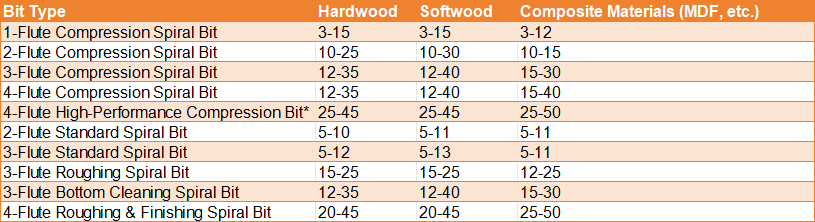
Important Note: Actual feed rates are affected by multiple variables, including the rigidity of the workpiece and CNC machine, material type (hardwood vs. softwood), collet condition, spindle horsepower, and the sharpness of the cutting edge.
We recommend starting at a moderate feed rate and gradually adjusting until you achieve the desired finish.
• Small-diameter tools: Reduce the feed rate
• Large-diameter tools: Increase the feed rate