
The Role of sizing (nesting) tools in woodworking
In the manufacturing of panel furniture and solid wood products, panel sizing (nesting) is the crucial first step. It involves cutting whole panels or square stock into rough blanks of the required dimensions to prepare them for subsequent processes such as profiling, edge banding, and drilling. Therefore, the quality of Woodworking nesting tools directly impacts material yield, processing efficiency, and the quality of the finished product.
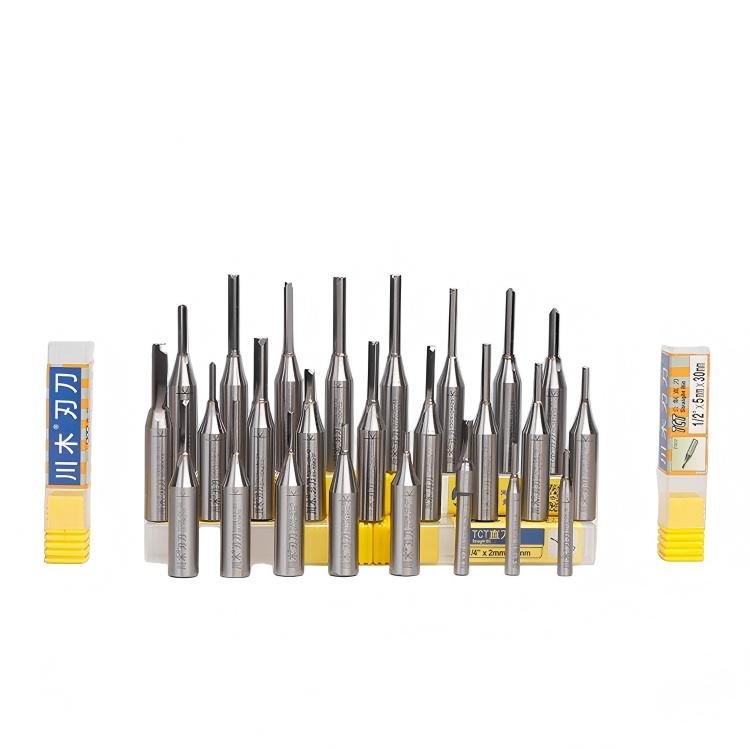
Types of woodworking nesting tools tools
Nesting tools aren’t a “one-size-fits-all” deal. You have to pick the right one based on your material, machine, and job requirements.
- Straight router bits
The most common type is the straight bit, which usually has two, three or four flutes. They typically have a steel shank with brazed carbide edges or are made of solid carbide. Standard straight bits lack rigidity; if fed too quickly, they can leave tool marks, vibrate excessively or even break. Conversely, solid carbide (TCT) bits are much more rigid and efficient, making them ideal for cutting plywood and solid wood. For example, when cutting plywood with its cross-grain fibres, a single-flute spiral bit is best. The spiral edge slices right through the fibres smoothly, minimising chipping.
- Spiral router bits
These come in single, double or triple flutes. Single-flute bits are ideal for plywood and MDF. Double-flute bits are ideal for curved cuts and drilling. Triple-flute bits can even act as temporary drill bits, making them ideal for straight or curved mortises.
Pro tip: if you’re cutting double-sided laminated boards (such as melamine), you absolutely need a compression bit. Its up-cut and down-cut design ‘pinches’ the top and bottom surfaces together, completely preventing tear-out on both sides.
- Multi-functional bits
Today’s custom furniture factories love ‘all-in-one’ tools. For example, a three-flute straight bit with a drill point can handle nesting, trimming, bottom cleaning, grooving and drilling. There are also tools that combine drilling and cutting. Using one tool for two jobs saves time spent changing tools and reduces clamping errors.
Choosing the Right Tool for the Material
1.Solid Wood & Hardwood: These have thick fibers, high density, and strong cutting resistance. You need rigid, razor-sharp TCT straight bits or 3-flute bits. Keep the feed rate steady—don’t push too fast, or the cutting edge will chip.
2.Plywood & MDF: Made of pressed chips and strong fibers, these are better handled by single-flute spiral bits. The continuous slicing action prevents “chewing” the fibers, leaving a much smoother cut.
3.Double-Sided Laminated Boards (Melamine, Fireproof boards): These are notorious for chipping on the edges. Always use a Compression Bit. The opposing spiral forces push inward (one up, one down) to lock the surface layer in place, preventing peeling.
4.Thin & Easily Deformed Boards: Use a bottom-cleaning bit for shallow grooving. It creates less cutting resistance, so it won’t bend or warp the panels.
Tool Usage Varies by Machine
1.Sliding table saws: These are great for small batches and are manually fed and guided by a fence. They use a combination of a scoring saw blade and a main saw blade. First, the scoring blade makes a shallow 1.5–3 mm cut, and then the main blade cuts all the way through to prevent bottom blowout. Ensure that everything is clamped perfectly straight and that the base is flat; otherwise, your dimensions will be inaccurate.
2.Computer Beam Saws (Panel Saws): These are auto-fed and computer-controlled for mass production. For the main blade, choose either TCG (Triple Chip Grind/TR) or ATB (Alternate Top Bevel/WZ) teeth. Use ATB teeth for melamine boards to prevent chipping and TCG teeth for hard materials such as cement particle boards. Pay attention to the kerf: the scoring blade should be 0.2–0.3 mm wider than the main blade; otherwise, the main blade will damage the laminate.
3.Nesting CNC Routers: Perfect for custom shapes and flexible tooling. You can use 3-, 4- or 5-flute spiral bits and easily swap specialised tools in and out of the ATC (Auto Tool Changer) magazine. For example, use roughing bits for thick boards (ideal for chip clearance) and finishing bits for thin boards (to achieve an extremely smooth finish). Fully automated nesting cells nowadays handle everything from loading and cutting to offloading and scrap recovery, saving both labour and materials.
If you still don’t know how to looking for Woodworking nesting tools, welcome to contact LIHOTOOLS.