
To choose router bits for plastics, identify the exact material grade, fillers or reinforcement, machining operation and required finish before selecting the cutter. A tool that works well in one plastic may be unsuitable for another, even when the sheets look similar. Cutter geometry, cutting-edge material and operating conditions need to be considered together.
LIHO Tools can manufacture plastic-cutting tools according to the customer’s specified material and machining requirements. The starting point is a clear application brief—not simply a request for a “plastic router bit.”
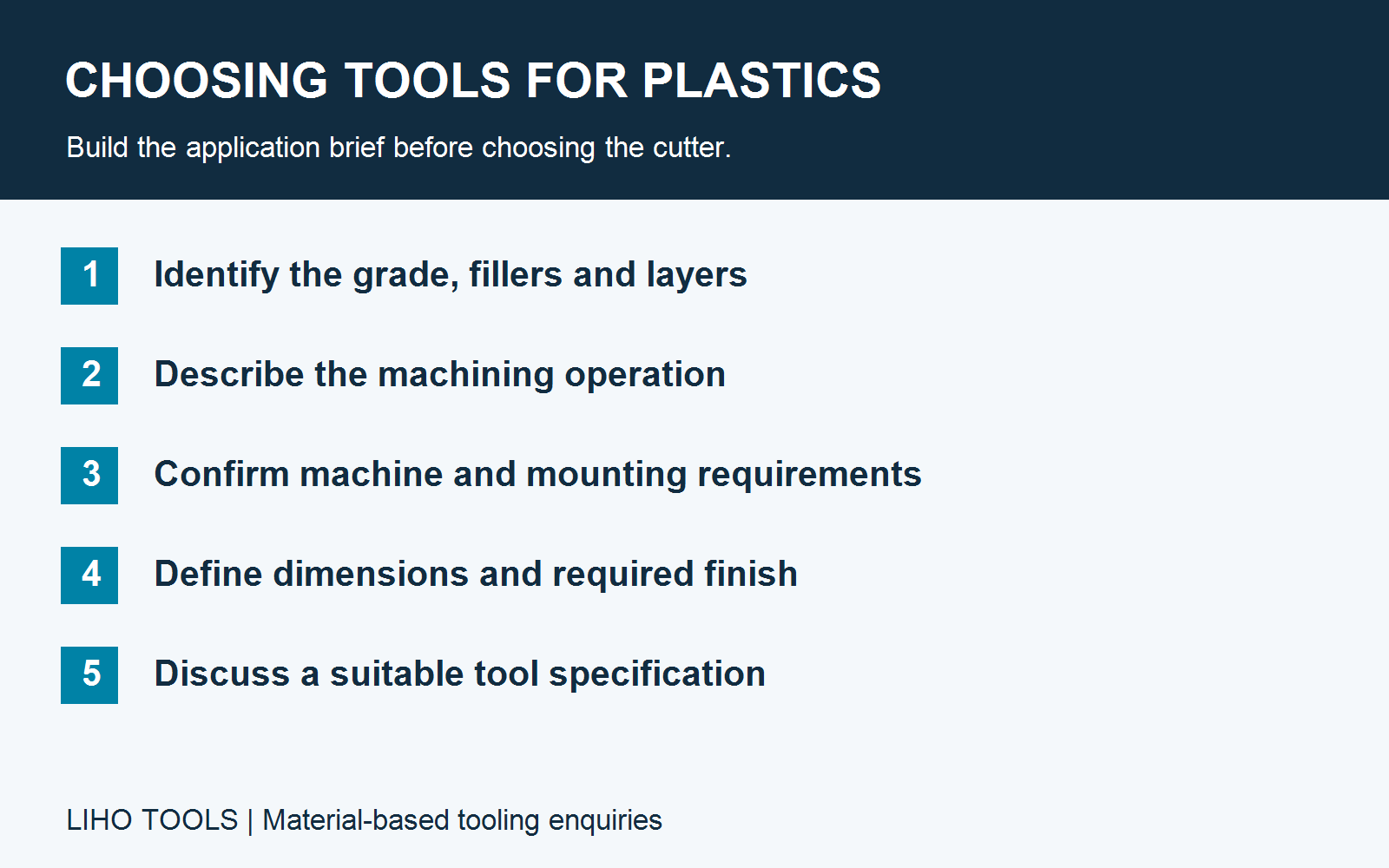
Start with the material specification
Ask your material supplier for the product name, resin designation and grade. Include a technical data sheet where available. State whether the material is unfilled, mineral-filled, glass-fibre reinforced, carbon-fibre reinforced or made from several bonded layers.
Descriptions such as “hard plastic” or “black plastic” leave too much uncertainty. They do not identify the formulation, reinforcement or surface layers that the cutter will encounter.
For multilayer sheets, describe every layer and its thickness. A clean visible face may require a different approach from an edge that will be concealed or processed again.
Describe the operation before choosing the geometry
Cutting through a sheet, trimming a moulded part, machining a pocket and producing a shaped edge are different applications. Specify which operation is required and where the finished surface will be inspected.
| Application information | What to provide | What it helps establish |
|---|---|---|
| Material | Exact grade, data sheet and filler or reinforcement details | The material the cutting edge must actually machine |
| Workpiece | Thickness, drawing and any surface layers | Cutting reach and the surfaces that need protection |
| Operation | Through-cutting, trimming, profiling, slotting or pocketing | Engagement and access requirements |
| Machine and mounting | Machine model, holder type and shank requirements | Compatibility and practical operating constraints |
| Quality target | Dimensions, tolerances and acceptable edge appearance | What counts as a successful cut |
| Current process | Existing cutter, feed, RPM, depth and photographs of defects | A useful baseline for reviewing the application |
Understand the design trade-offs
Cutting-edge sharpness and support
A sharp edge can help a plastic cut cleanly, but sharpness is only one consideration. The geometry must also support the edge through the intended operation. Rake and clearance should be selected for the specific application rather than copied from an unrelated wood or metal cutter.
There is no single rake angle or clearance angle that LIHO recommends for every plastic. A drawing or sample of the workpiece, together with the material specification, provides a better basis for discussing the design.
Flute space and chip evacuation
The cutter needs room to move removed material away from the cutting zone. A blocked flute or repeated recutting can disrupt the process. Flute count and shape therefore need to suit the material, engagement and available feed capability.
A single-flute or O-flute cutter is one option for suitable applications; neither description establishes that a tool is right for every plastic. For a closer look at these designs, read our guide to single-flute bits for acrylic and polycarbonate.
Cutting-edge material and abrasive reinforcement
Filled and reinforced grades deserve separate consideration. Ensinger’s engineering-plastics guidance identifies carbide, ceramic or diamond-tipped tooling as options for reinforced plastics where conventional steel tooling has limited durability. This supports evaluating wear resistance for the actual grade, rather than choosing from the base resin name alone.
It does not mean PCD is automatically the best choice for every reinforced component. Tool geometry, operation, finish requirements and production economics still need assessment. Confirm the proposed cutting-edge material for the specific job.
Separate a tooling problem from a process problem
Poor finish does not, by itself, prove that the cutter needs redesigning. Review the tool, workholding and cutting conditions as a complete setup.
- Smearing or material adhering to the cutter: inspect edge condition, chip evacuation and the suitability of feed and spindle speed.
- Chipped or damaged edges: review material behaviour, cutter geometry, entry and exit moves, and support near the cut.
- Vibration or inconsistent dimensions: check mounting, tool projection, part support and engagement before assuming a different blade shape will solve it.
- Rapid wear: identify fillers, reinforcement and any abrasive surface layers, then discuss the cutting-edge material and process with the supplier.
These are investigation points, not guaranteed diagnoses. Stop the machine before inspecting or clearing the cutter.
LMT Onsrud’s plastic-routing guidance also describes surface damage as dependent on several factors, including tool geometry, plunge speed, spindle speed and fixture support. Changing one number without understanding the setup can leave the underlying cause unresolved.
Treat feed and RPM as application settings
Do not use a universal “low RPM and fast feed” rule for every plastic. Request starting data for the actual tool and operation, stay within machine and tooling limits, and verify the result on representative material.
Record feed, RPM, cutting depth, radial engagement, entry method and workholding alongside the material and tool identification. A successful trial is more useful when the conditions can be repeated.
Our CNC router feeds and speeds guide explains the calculation and terminology using wood-routing examples. It is not a plastics parameter chart and its examples should not be transferred directly to this application.
Request a custom plastic-cutting tool from LIHO Tools
LIHO Tools can manufacture tools for the specified plastic material and machining requirements. To start the discussion, send:
- The exact material name and grade, including reinforcement or filler content if known.
- A part drawing, sheet thickness and details of any bonded or coated layers.
- The machining operation, required dimensions and edge-finish criteria.
- Machine, holder and shank requirements, plus tool dimensions or access restrictions.
- Current cutting settings and photographs of the problem, if replacing an existing tool.
If the material is unknown, say so rather than substituting a guessed resin name. Discuss what further identification or sample information is needed before finalising the specification.
Contact LIHO Tools to discuss your plastic-cutting application. A clear material specification helps turn a general enquiry into a practical tooling brief.
Common questions
Can I use a woodworking router bit to cut plastic?
Some cutters may be suitable for particular plastics, but suitability must be checked against the tool’s material recommendations and application data. A successful wood cut is not evidence that the same tool and settings will produce the required plastic edge.
Is a single-flute bit always the best choice?
No. It is a useful option for certain jobs, but flute count must be considered with the plastic grade, geometry, engagement, machine capability and finish requirement.
What does LIHO need before discussing a custom cutter?
Provide the material grade, drawing or dimensions, operation, machine and mounting details, and required finish. Include fillers, reinforcement and multilayer construction; these details can materially affect the tooling discussion.
Technical references
- Ensinger: machining guidance for engineering plastics
- LMT Onsrud: Preparing for Plastic Routing, Part 2
These references support general machining principles. They are not cutting-parameter approvals or performance guarantees for an unspecified LIHO tool.